
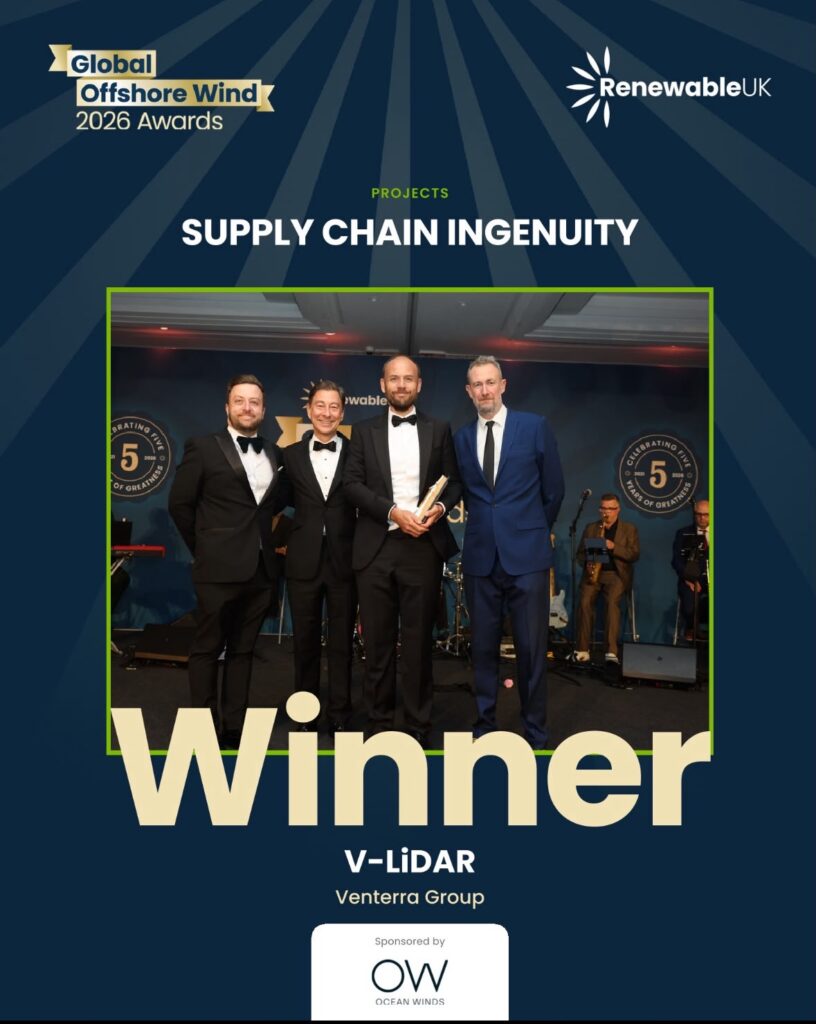
Partrac is celebrating a major industry achievement after V-LiDAR was named winner of the Supply Chain Ingenuity category at the RenewableUK Global Offshore Wind Awards 2026. The award recognises the innovation, engineering and collaboration behind a new generation of floating LiDAR technology designed to make offshore wind measurement safer, more efficient and more reliable.
The award, presented at last night’s Global Offshore Wind Awards by comedian Alex Horne, recognises the contribution V-LiDAR is making to the offshore wind supply chain through its innovative design, operational efficiencies and potential to reduce the risks and costs associated with offshore measurement campaigns.
Developed by Partrac in collaboration with sister company Osbit, V-LiDAR brings together more than 20 years of Partrac’s metocean field experience with Osbit’s expertise in robust subsea engineering. The result is a floating dual LiDAR system designed from the ground up to address the challenges and limitations identified through years of experience in the floating LiDAR market.
Engineering a smarter approach to offshore wind measurement
Reliable wind resource and metocean data are essential to offshore wind development, supporting critical decisions throughout project planning, consenting, financing and design. Collecting this data, however, presents significant operational challenges, particularly as offshore wind projects move further from shore and require longer, more complex measurement campaigns.
V-LiDAR was developed to address these challenges by rethinking how a floating LiDAR system is designed, deployed and maintained. Rather than adapting an existing buoy platform, the team drew on experience across the offshore sector to develop a system that places operational efficiency, safety and data integrity at its core.
Key innovations include an integrated lifting arm and single-point lift designed to simplify deployment and recovery, reduce manual handling and minimise the need for personnel transfers between vessels and the buoy. Its modular, hot-swappable design also allows equipment modules to be replaced offshore, helping reduce intervention times and avoid unnecessary interruptions to data collection.
The buoy’s hull has been optimised for stability and towing, addressing practical challenges associated with transporting and handling floating LiDAR systems. Meanwhile, its digital architecture combines secure, high-frequency 1 Hz satellite and broadband communications with Partrac’s cloud-based V-Data platform, delivering live, quality-controlled and fully audited metocean data directly to developer portals via APIs.
Together, these features demonstrate how considered engineering can address real-world supply chain challenges while improving the delivery of offshore wind measurement campaigns.
Reducing offshore interventions and improving data availability
One of V-LiDAR’s key differentiators is its ability to support deployments of up to 20 months through its power-management systems. Compared with legacy systems that routinely require servicing every six to 12 months, this extended deployment capability offers greater flexibility when planning maintenance around seasonal weather windows and vessel availability.
Fewer planned service visits can deliver significant operational benefits. Across a two-year campaign, V-LiDAR has the potential to reduce vessel days by up to 50%, helping to lower operational costs, reduce maritime emissions and limit personnel exposure to offshore risks.
Reducing the frequency of servicing also helps minimise downtime and supports greater data availability. The V-LiDAR system has the potential to deliver up to a 2% increase in data availability over a two-year campaign through reduced servicing downtime, while its real-time data transmission architecture supports the timely delivery of high-resolution information.
For offshore wind developers, these improvements can contribute to more predictable measurement campaigns, greater confidence in the data underpinning project decisions and a more efficient approach to site investigation.
A significant investment in UK offshore engineering
V-LiDAR represents a £10 million investment in UK engineering and manufacturing. Designed and manufactured in the UK, the system is assembled at Osbit’s facility at the Port of Blyth, demonstrating the value of collaboration across the domestic offshore engineering supply chain, and the Venterra Group.
As demand for offshore wind continues to drive the need for dependable, high-integrity measurement data, V-LiDAR provides a commercially deployed solution with the potential to support projects across the UK and international markets, including Europe, Asia and North America.
The platform has already gained traction with major offshore wind developers, with Partrac investing in fleet expansion in response to client demand.
The award also builds on previous recognition for the technology and Partrac’s approach to safety. V-LiDAR was named Technological Breakthrough of the Year at the IIRSM Risk Excellence Awards 2026, while Partrac received The Crown Estate’s Safety First Award in 2026, recognising its commitment to safety during large-scale metocean survey campaigns.
Celebrating innovation and collaboration
Winning the Supply Chain Ingenuity Award is an important milestone for Partrac and everyone involved in the development and delivery of V-LiDAR. It recognises the collective expertise, practical experience and engineering innovation required to turn operational challenges into a solution with tangible benefits for the offshore wind industry.
Partrac also congratulates all the winners and nominees at the Global Offshore Wind Awards 2026. It was a privilege to be recognised alongside so many organisations and individuals helping to advance offshore wind through innovation, collaboration and technical excellence.
As the industry continues to scale, solutions that improve safety, strengthen supply chain resilience and deliver reliable data will be increasingly important. V-LiDAR demonstrates how collaboration and a focus on real operational needs can help deliver those improvements.